[Q & A: Playing Technique] Right and Left Hand Playing Techniques

Hi!
I got a couple of questions from one of my readers and thought I share my answers with you!
The questions are about right and left hand techniques. Here’s basically my take on that. Feel free to comment (below the post) or send an email about this or other topics to ubasslessons@gmail.com

Right hand technique
What technique I choose to use depends on (at least) a couple of things.

1. Music style/sound
– Do you need a ‘fat’ tone?
Thumb style mute might work for this. See this video (I will probably make more videos about this too!). Depending on where you pluck the string will also make your tone more or less ‘fat/full’. Plucking close to the bridge will get you a thinner sound but it will be easier to play faster since the string is ‘harder’ here and will bounce back easier. The amp you use and the EQ settings (on the amp, preamp of on the UBass if you play a SUB of California Solidbody can of cause also help you ‘fatten’ your sound. But changing the sound only with your hands is a quicker way and can make subtle changes in the blink of an eye!

Sidebar: When I play on a regular fretless bass with more sustain than the UBass I tend to vary my right hand placement to get the sound I want. Sometimes I pluck the strings where the fretboard ends and even around the last frets to get the best and most ‘fat/full’ sound! Why not try this on the Ubass too! Sound vs. speed can be tricky since the string really bounces back more closer to the middle of the string.

– Do you need speed?
Alternating two fingers (or more) can of cause give you more speed. And please also consider what I wrote above regarding placement on the string.

2. The construction of the bass.
– On the acoustic UBass there are no place to anchor your thumb so this makes it necessary to find a technique that works. I showed examples of this in my first playing technique video.
On a regular electric bass there is almost always a pickup where you can put your thumb. BUT the placement of the pickups differ and sometimes you can’t use this approach. There is however another great way of going around this. Sidebar: On old Fenders there was a fixed rest where you put your index and middle fingers so you easily could play with your thumb..! And later on they put a thumb rest instead…) you can use the E-string to anchor your thumb and the move it when you have to play that E-string. I use this technique a lot since I play different basses and can’t rely on pickups being in the right place.

Left hand technique
Deciding if I play a bass part on the same string or more strings depends different things. I’ll try to talk about a few.

1. If the bass figure is easier to play on one string then please do that!

2. I often tell my students that they should avoid open stings to get more of a consistent tone! (I also say that playing walking bass is an exception. Here I want to emulate the feel of an upright bass where it’s ‘crucial’ to use open strings to get the right sound and of cause a reference to in-tune strings).

3 Playing ‘linear’ on one sting vs. using more strings. Please try to play the same thing in more than one way! This might help you find that one or the other is best suited for that particular bass part or a specific couple of bars in the bass line.

Examples

Left Hand

Here comes two examples of different ways of playing the same bass part.
Also check out my lesson on the song ‘Satellit’ (Ted Gardestad) in Lesson 7.
In that song I use the extended fingering technique you will see in the two songs below.

”Another One Bites The Dust’ (Queen) (Why not check out the Weird Al Yankovich cover ‘Another One Rides The Bus’ for a crazy cover).

20120713-000820.jpg

20120713-003446.jpg
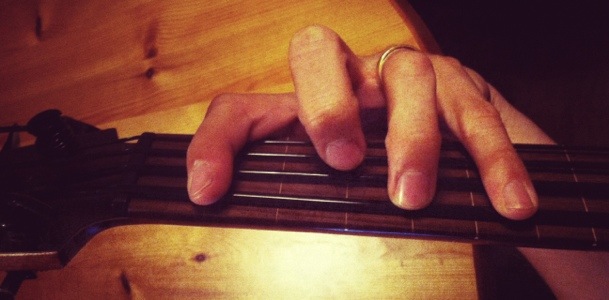
Play the riff on two strings

20120713-000929.jpg

20120713-003509.jpg
Play the riff on one string using extended fingering. On the short scale Ubass this is quite easy but not always the best way. It’s of cause up to you to decide what will work best for you in different situations.
20120713-004422.jpg
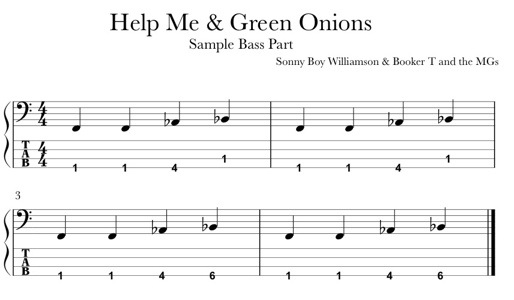
Another example is the quite simple riff in Help Me (Sonny Boy Williamson) and also in Green Onions (Booker T. And the MG’s) It can also be played on two strings or one string using the same techniques as I mentioned above!

More technique stuff will come in the future. As I wrote in the beginning of this post please let me know if you have any questions regarding playing technique of other UBass questions and I will try to answer them!

Good luck!
/Magnus

[Rehearsal Report] Jammin’ with my Kala UBass | Blues: ”Long time no PLAY”

20120702-020958.jpg
Mattias Pettersson, Magnus, Hannes Nordgren

Hi!

Yeah! Finally I have once again played with my old friend Mattias Pettersson! We started to play back in the late 90s.
We had blues bands and played in the rhythm section in a small big band. Later on we had a band playing a lot of jam based music.
I guess it must have been at least 5-6 years since we last played together. Too long!
My brother-in-law (also featured in the last Jammin’ video) joined in on drums.

On this first rehearsal/jam we tried an old tune I started writing in the late 90s. I found it a couple of weeks ago. It’s basically a blues based around a bass riff. I ad libed a scratch vocal part based on the working title of the song, ”You took my blues away”.

We sure had a great time and will hopefully play more this summer. This song and maybe one more will probably end up on my recording project ”Speaking UBass!?” Read more about the project here.

I played on the Kala S.U.B. throughout the rehearsal/jam. I’m starting to get a bit more used to the fretted neck but I’m still more comfortable playing my fretless spruce UBass. A little more practice and I hope it will feel more relaxed with the SUB too!

We did record some audio and video. I might post some of it later!

Please check out some of Mattias playing on this YouTube channel!

Thanks for a nice jam/rehearsal guys!

Mattias Pettersson, guitar
Hannes Nordgren, drums
Magnus Sjöquist, Kala S.U.B UBass

20120702-020853.jpg

[Gig Report] Gospel music on the Kala SUB

20120627-152926.jpg
Rehearseing with the Kala SUB

Hi there!
A couple of weeks ago I played a gig featuring gospel music. I used the Kala S.U.B. on a couple of songs (and my Ares 5-string and Rob Allen fretless MB-2 on the rest).

I played the SUB through my Headway preamp. Used the a/b function on the Tech21 VT Bass Deluxe and then to my Aguilar Tonehammer 500 and SL-112 cab.

I used the SUB on the more ‘spiritual’/traditional songs.
I might feature some gospel music on the ‘Speaking UBass!?’ project too, we’ll see 🙂

20120627-152953.jpg

Jammin’ with my Kala UBass | 22

20120613-191028.jpg

Hi!

Let me introduce you to my brother-in-law, Hannes Nordgren. He plays great drums on this ‘Jammin’-video!
This is my second video that features the Kala S.U.B UBass! I’m playing through my regular electric bass setup.

Signal chain:
Kala SUB UBass
1. Morley Volume/Wah (in Wah mode but set to a ‘static’ value to get a nice ‘nosy’ tone into my…)
2. Boss Bass Syntheziser SBB-3 (Envelope filter setting)
3. old Boss Digital Delay DD-3
4. even older Boss Octaver OC-2
5. Tech 21 VT Bass Deluxe
6. Amp: Aguilar Tone Hammer 500
7a. DI out into Universal Audio Twin-Finity 710 then TC Electronic Konnekt 24D and Apple Mac w/Logic Pro 9
7b. Speaker out into Aguilar SL-112 Speaker Cab

I wanted to make a video using the UBass in a ‘electric bass setting’. Trying to play like I would if I used for example my Fender P-bass. The jam start out with the uneffected bass. Then it ‘morphs’ into a effect ‘drenched’ bass sound with envelope filter and ‘static wah’! During the bass solo I also add a delay to make it even more ‘drenched’ 🙂
The bass and drum parts are played live without a click. Then I overdubbed the two guitar parts (funk comping and solo).

There are two versions on the video:
1. Bass, drums and guitars
2. Only bass and drums

I think the sound is quite full and the SUB works pretty well through effects too!

Hope you like it!

Right now I’m working on a review of the SUB. I know there are others that have already done this but I will make comparisons to the acoustic UBass and other basses that have roughly the same ‘function/tone’ as the SUB!

Take care ya all!


[Style Study – UBass Lesson 8] Jazz: Walking Bass | Part 1

Hi!

Ok time for some jazz again! Thanks to Susan C. for your suggestion!

In this lesson I will feature the jazz standard ”The way you look tonight” written by Jerome Kern. This song has been covered a thousand times by as many artists.

But I have a favorite version!

In 1995 one of the most famous jazz singers in Sweden, Svante Thuresson, released the CD ‘Jag är Hip, Baby!’. (Eng: I’m hip baby)
This album features the wonderful lyrics of another famous Swede Mr. Beppe Wolgers! Here’s a link to a web page about him [in Swedish]
He wrote all the Swedish lyrics including the ones for ‘The way you look tonight’. It became ‘Sången’. The lyrics is a celebration to Music and tells the story of the performer and the listener and that you need both to have the complete experience of Music! So true!!

If you use Spotify here’s a link to the version I mentioned above!

Here’s a YouTube clip of an audience recorded video from 2010. (Not the best sound or picture but still…)

Ok. Let’s get on with the lesson!

I’m gonna do one a couple of versions. One in medium-up tempo and maybe even one in uptempo.
And I will also do a slowed down version of the medium-up tempo.

Before we start let’s talk a little bit about what walking bass is and how you could think when you make your own bass parts!

Walking!
First of all: To make your walking bass parts work you have to have a basic understanding on how chords are built. The general idea of walking is to navigate through the chords using quarter notes. Just as you would walk from one place to another using your feet! You could play the same note (the root, probably) over and over again but that would be just like standing on one spot just moving your feet up and down…and that wouldn’t take you very far 🙂 You could just play random quarter notes but after awhile this approach is going to get to ‘out there’ for most regular playing situations. (Just like walking around with no goal…(That can sometimes can be a good thing though…:-)

I think a more chord based approach is what you should work on. This will help you get a firm knowledge and act as a starting point. Then go from there using notes from the different scales that correspond to the different keys and chords in the song you choose to play.

There’s quite a lot going on harmonically in ‘The way you look tonight’ and if music theory is new to you maybe this will be a bit hard. But I’ll try my best to make this as understandable as possible! I will make more lessons based on easier songs if you want! Just send an email to ubasslessons@gmail.com and ask away!

Basic music theory
Let’s divide chords in three basic categories. Major, minor and dominant.
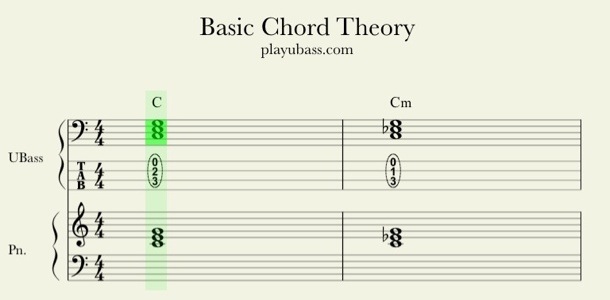
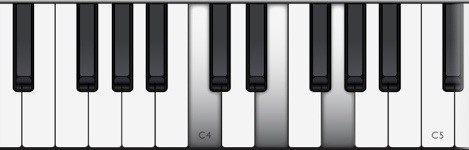
A chord is based on a so called triad. In C major it’s C E G. On a piano it’s three white keys with a white key in between. (This is not always true. It depends the chord and key!)
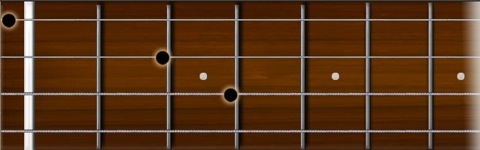
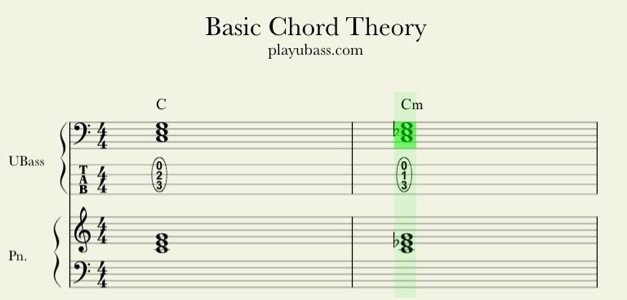
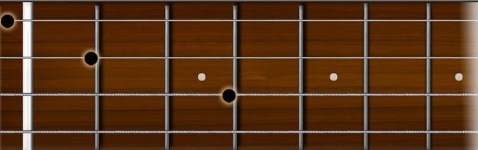
You can look at it like this: From C to E there’s 4 half steps (On a fretboard it looks like the picture below. I will explain this further in Part 2 of this lesson!). From E to G there is 3 half steps. Se picture below. In a C minor chord it’s the opposite way! From C to Eb (flat) there is 3 half steps and from Eb (flat) to G there is 4 half steps.
Ex. C Major: The notes that make up the triad/chord are called root (C), third (E) and fifth (G). (These names correspond to the C Major scale and refers to the scale degrees).

As you can see below, on the first 4 chords of the song, it’s also common to add a forth note to these chord. This is the seventh degree. In a major chord this will be the major 7 (ex. C7: C E G Bb (flat)) and in a minor chord this will be the minor 7 (ex. Cm7: C Eb (flat). A Dominant 7 chord has the minor 7. In C Major the Dominant 7 chord is G7, a fifth from C (G7: G B D F) More on chords and scales in this previous lesson.

20120610-133400.jpg
C Major Triad (UBass – Bass Clef and TAB + Piano, Left Hand)
20120610-133558.jpg
C Major Triad (Piano)
20120610-133649.jpg
C Major Triad (UBass Fretboard) TIPS! You can play the G on the 5th fret of the D string too!
20120610-133851.jpg
C Minor Triad (UBass – Bass Clef and TAB + Piano, Left Hand)
20120610-133904.jpg
C Minor Triad (C Eb G) (Piano)
20120610-133916.jpg
C Minor Triad (UBass Fretboard) TIPS! You can play the G on the 5th fret of the D string too!

Here are some basic chords in the Major, Minor and Dominant category
Major
C
Cmaj7 (Sometimes you’ll see this as C ”triangle” 7, see the first chord of the song below!)

Minor
Cm
C-
Cm7

Dominant
C7

These are just a starting point. What dictates how the chord is built is often decided upon how the melody is written. You could look at it as the chords are made to fit a specific melody! Sometimes the melody comes first but there are of course times when you come up with a nice chord progression first and then make the melody. One way to make the chord fit the melody is to add ‘extension’ notes like the 9th, 11th and 13th degrees. These are not ‘new’ notes. They are the same as the ‘regular’ notes of the scale but one octave up!
Ex. C major: 1C 2D 3E 4F 5G 6A 7B 8C and then it start all over again 9D 10E 11F 12G 13A. Sometimes you make alterations to these ‘(ex)tensions’. You can raise or lower these extensions depending on the melody and the sound you strive for.

Some examples of these ‘extension’ chords
Major
C9
C11
C13
C7b5b9
C7#5#9

Minor
Cm9
Cm11
Cm13
CØ9 (half diminished) or Cm9b5

So how does this help you when you want to play walking bass? Well if we look at the first 4 chords in our song we can see that there are both major and minor chords.

20120611-110328.jpg

As a basis for our walking bass we’ll look at the core of the chords/triads which I mentioned above, the root, third and fifth of each chord. In the next lesson we will go through the chords and check out what notes that will fit the different chords and how to combine them to make a ‘musical’ and hopefully flowing bass line!

Stay tuned for Part 2, with the actual bass parts, coming soon!

Good luck and feel free to comment or send an email to ubasslesssons@gmail.com if you have any questions and I’ll try to help you out!

[Studio Report] – Record the UBass using mics! – Part 2

Miking the UBass! (Headway EDB-1 preamp, Røde NT1-A, Oktava MK-012, Golden Age R1 and AKG C414)

Hi!
Time for part 2!

Ok. Let’s listen to, and talk about, four of the five microphones I talked about in the previous post.
I will let you make up your own minds what microphone you like the best. But I have my favourite 🙂

What microphone you prefer can depend on quite a few different things.
Here are a few:

• Different playing styles (more of less muting, ‘index-middle’ or thumb playing…)
• Genre of music
• Solo UBass, duo settings or in a dense mix?

In this ‘lab-video’ I wanted to capture the beautiful tone you can get when you play a high register melody on the fretless version. But I think it also makes regular bass parts sound a bit more organic! This is of cause something you have to experiment a lot with and it will probably work with whatever mic you have. If you don’t have one then you could consider these mics a starting point in your search for one. In my test I recorded in my quite small and not so ‘lively’ sounding studio. I will try to record in bigger rooms and maybe in a church which of cause has a totally different sound and acoustics to compare. But that’s another ‘lab’…

Please let me know what you think! Write your thoughts in the comments below or send a email to ubasslessons@gmail.com

If you want I can upload more sound files to let you hear the different combinations with the added ‘lined-through-my preamp’ sound!


UBass Day @ Musicians Institute May 30 2012

UPDATE: I’m working on a couple of different new blog posts right now. It’s Part 2 of my ”Miking the UBass” test and a new lesson.
In the meantime please check out this video from the Ubass Day at the Musicians Institute in Los Angeles on May 30.

As you can see it’s pure joy to play the UBass. Just look and listen to Abe and Bakithi!

Happy Ubass to ya all!

[Studio Report] – Record the UBass using mics! – Part 1

Miking the UBass! (Headway EDB-1 preamp, Røde NT1-A, Oktava MK-012, Golden Age R1 and AKG C414)

Hi!

I’m trying out new ways to record the UBass. Up until now I have used only the DI in my Headway Preamp into my Universal Audio Twin-Finity 710 (tube/solid state) preamp or my Fishman preamp into the same UA preamp. Recently I started to put a mic on the speaker cabinet (different ones depending on where I recorded). I then mixed that signal with the DI/line signal.

Now I’ll put a mic in front of the UBass to pick up on the acoustic sound coming directly from the UBass.
With this approach comes a couple of things to consider.
First of all; the UBass is really not that loud acoustically (this is of cause nothing new to those who have played the UBass). The ‘loudness’ can differ depending on if you use the stock strings or another of the available sets. (Read more about the different strings here and here). I haven’t yet tried other strings than the stock ones but will do that as soon as possible. This approach will probably work best in a controlled studio environment. On a live stage the ‘leakage’ from other instruments will probably make it hard to get a good and solid tone from the UBass since you have to compensate for the low volume coming from the the instrument acoustically. It might work with a super cardioid mic. (I’ll try this in a future lab!)

Studio Labs
Ok. How should you do to record the acoustic sound from the UBass?
Well here are some suggestions based on my different ‘labs’.

I tried different condenser microphones. Large and small diaphragm. I also tried a ribbon microphone and a tube condenser to make it a nice ‘roundup’. The tube condenser mic is visible in this photo. (This photo was taken during a session with Nelson Faria. Read more in this post.)

I chose to play the melody to the song ‘How insensitive’. (Jobim). (Right now I’m working on a recording project that might feature that song. So it was convenient to try this technique on that tune.)

As a background for the melody I’m using one of the over 100 CD’s by Jamey Aebersold. These are made for practicing melody, improvisation skills and bass lines (mostly walking bass) on mainly jazz tunes. But there are other genres represented like the Bossa Nova tune I used in the ‘lab’.
(This song is featured on vol. 98 Antonio Carlos Jobim – Bossa Nova).
These Aebersold CDs use a neat ‘minus-one’ feature. If you pan hard right you can remove the bass part. If you pan hard left you remove the piano/guitar (Some tunes are with guitar and others with piano).
I used this feature to make my recording a bit more authentic. Since you hardly ever play with two bass players (Ok, there are exceptions. Please check out live recordings and shows with Victor Wooten for an excellent exception!) I muted the regular bass part so the UBass melody was the only bass instrument. This will also let the listener focus in on the ubass melody/solo OR bass part.

The different microphones in the ‘labs’

Mic 1 (Oktava MK-012 in super cardioid and cardioid mode)

Mic 2 (Microtech Gefell M92S Tube)

Mic 3 (AKG C414 XLII in cardioid mode)

Mic 4 (Golden Age R1 Active Ribbon)

Mic 5 (Røde NT1-A)

In part 2 you will be able to listen to the different mics. Maybe you will be able to pick out a favourite mic/type that you think sounds best? Hopefully you will at least get the chance to hear a couple of different microphone types and how well (or not) they work in reproducing the acoustic tone of the UBass! Link to Part 2

[Rehearsal Report] Kala Ubass goes Country!

20120524-172437.jpg

Let me introduce one of my guitar playing friends, Marcus Måttgård! Please check out some of his stuff on his YouTube Channel. In the photo above we rehearse some country tunes (by Jerry Reed) that hopefully will end up on my CD ”Speaking UBass!?”. The CD will feature different musicians and me playing UBass on all the tracks! (I might sneak in another bass on one or two tracks…) You can ‘REED’ 😉 more about it in my previous post or on the special page i just created that here at playubass.com!

On that page I will update the progress and and let you listen to some ‘snippets’ of the different recordings as I make them!

Yihaa ya all!!