I got a question about my view on playing in (or out of) tune on the fretless UBass. I decided to share my answer with all of you.
Q: Do you find that you’re fingering in between frets rather than directly on the fretline like you would with a regular fretless bass?
A: Sorry but there is not a simple answer to that question I’m afraid 😦 Since the scale length of the UBass is merly 20-21 inches all your muscle memory from playing a 34-35 inch fretless is not much of a help. BUT what really IS helpfull is if you have played
fretless bass of upright. Because then you’re probably used to listen as you play. That’s really the best way of playing in tune.
I find that I’m only ‘roughly’ use the fret lines as guidelines and than try to use my ear in ‘super-sensitive-mode’!
One more thing that is crucial to playing in tune is trying to get the best sound possible out of your UBass. You really have to HEAR what you’re playing. AND MOST IMPORTANT you have to hear what you’re fellow musicians are doing to be able to make it all work as a ‘unit’!
Ok. That might not be the answer you hoped for but it’s almost all about LISTENING!
I will try to do some specific lessons on playing the fretless UBass!
Back in Sweden again. Have been visiting India the past 3 weeks!
I got a request to do a transcription of one of my early Jammin’…videos.
It’s a jazzy blues improv. The drums is played by Morgan Ågren from the Toontrack Jazz EZX.
Since I only had my iPad with me on my travels I had to do the transcription on that.
I used a app called iWriteMusic with is quite good once you get a bit used to it. It doesn’t have the ability to make TABs so this first post is standard notation only.
TIPS! Check out latest post for updated and corrected PDF with TAB!
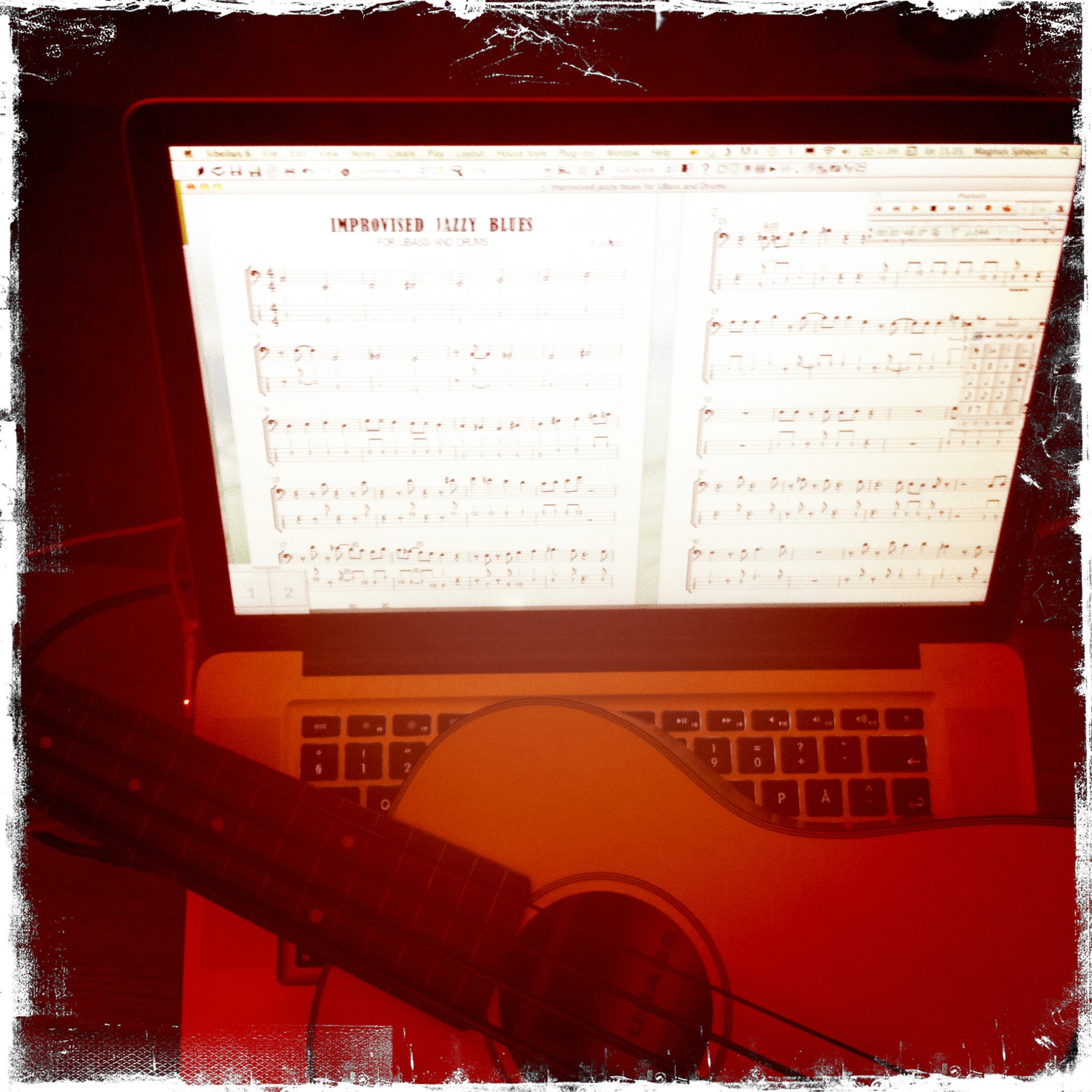
I will also try to make the usual PDF with both standard notation and TAB. Normally I use the great notation software Sibelius. It has a great way of making TAB from standard notation. This is by far the best way to read music. Having standard notation and TAB is great. That way I can easily show you my suggested fingerings. Using only standard notation doesn’t do that.
BUT it can also be a good thing since you will have to make up your own fingerings that might be better for you and makes you think more about HOW you play!
So let’s see if you play it the same way I did or not. In this particular case you can of cause watch the video and figure out my fingerings anyway. But if it was audio only, it’s not that easy.
Sibelius also has a ‘little brother’ called Scorch. It’s playback only and FREE on mac and PC. If you have and iPad you can get the app here
If you find this to be a useful tool I can make my transcription available in this format too. That way you can play back the song at different speeds and even change key if you want to.
This is my first lesson on UBass playing technique. I will cover some basics that I hope you will find helpful. I know I would have liked someone showing a bit of ”up-close-technique-stuff” when I got my UBass last year. Of cause my tips is based on my playing style and how I approach bass playing in general. I have played bass for some 25+ years so I guess I have developed some kind of ”personal technique” that works for me. Hopefully some of what I am about to show you will help you in your UBass explorations!
Hi!
I have received a couple do questions about how I amplify my UBass. One of the key things to get a good sound it that it’s super important to get a sound that has a lot of low end! The UBass is a really serious ‘low-end-monster’ and much of the greatness (besides playability and portability) is it’s ‘larger-than-body’ sound! So the key to a great sound lies very much in the amplification. I have done a great deal of gigs using the below signal chain with super great results.
This chain is ‘a killer’ setup! It’s not the cheapest but the sound is really HUGE with plenty of low end! And if you are going to play with others in a small to medium venue/room you can use it to amplify the other players as well. I’ve been using this setup with ‘Barnjazz – jazz för barn’ quite a lot and we manage to use the same single Bose L1 Compact System för lead- and background vocals, electric jazz guitar and of cause my UBass through the T1 ToneMatch mixer with a really great result. The Bose L1 Compact (or it’s ‘big-brother’ L1) is designed to be used as a ‘personal’ sound system (the idea is that the sound that you hear on stage is the same sound the audience hears. So ideally every musician should have a separate system so the audience can clearly hear where the musician is located on the stage. This is to get a perfect amplified stereo image of the ‘band stand’. BUT having one L1 (Compact or full) per musician is a bit pricy so using one L1 Compact for more than one musician is a good start! Than you can add more systems when you got the money (if you like) 🙂
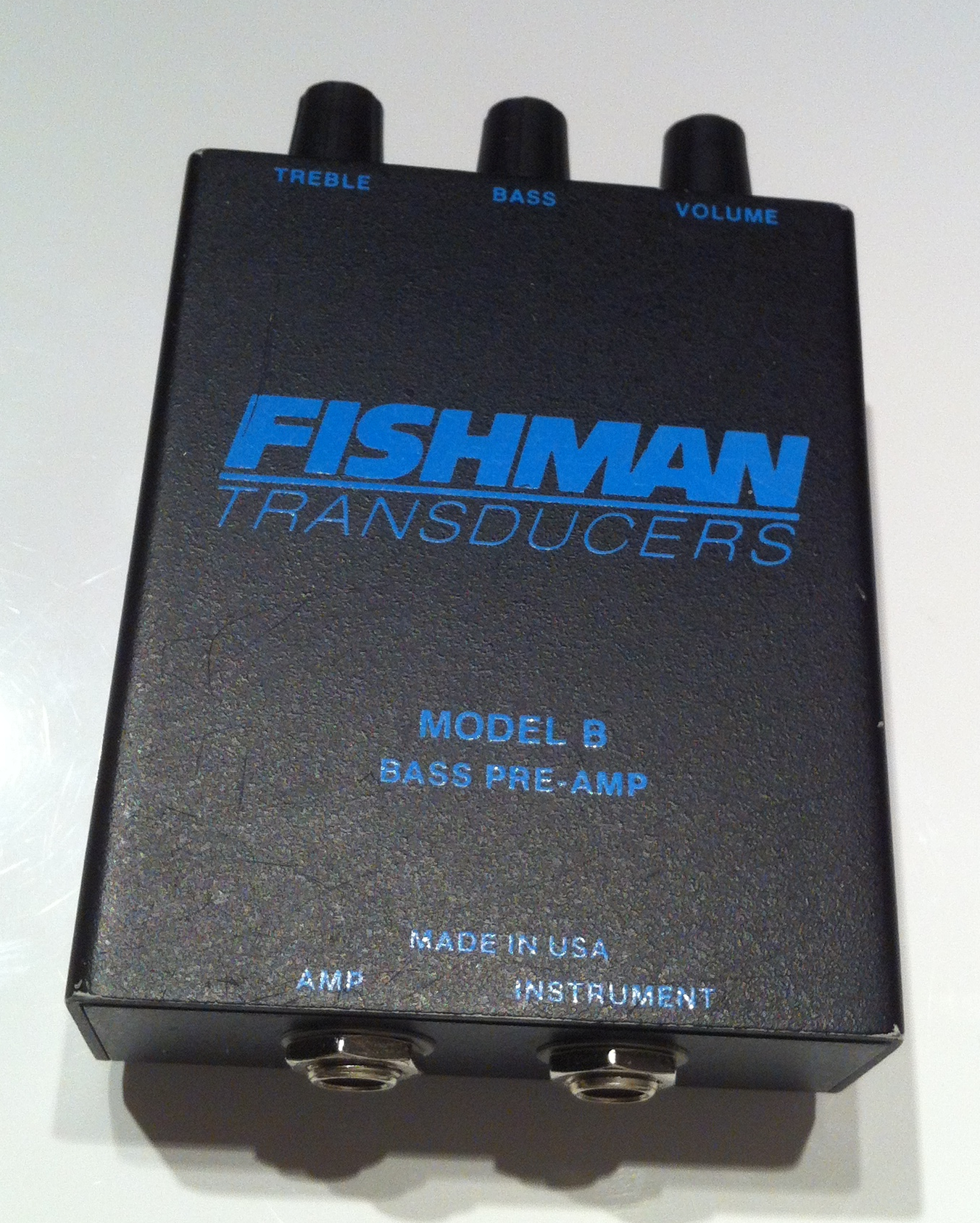
More about the using a preamp like Fishman Model B Bass Pre Amp (and other ones) before plugging into an amp or mixing desk
This is crucial if you want to get a warm, round and full sound! USE A PREAMP! You will definitely get much more greatness out of your UBass if you follow this advice! The little preamp I use right now is a ‘used’ (must be at least 15 years old) preamp designed to be used with an upright bass. It works really well! I’m planning to try out a couple of more pre amps soon for comparison. I’m especially interested in Headway EDB-1 Acoustic Preamplifier I’ve heard a lot about this little acoustic preamp and have got friends using it for acoustic guitar or upright. So it could be the next upgrade in my signal chain. But for now the Fishman Preamp suits my needs. I believe this one should be nice to try as well.
My other setup is quite new (part of it anyway). It starts with my trusty Fishman again. Then it’s a MarkBass Little Mark II that I’ve had for a couple of years. The MarkBass head is then hooked up with a quite new Aguilar SL-112 (Super Lightweight) 1 x 12 equipped cabinet. I’ve only used this setup for a couple of gigs so I’m still experimenting with EQ- and Compressor settings. Stay tuned for more about this set up later…
Other amps
Battery powered bass amps for outdoor gigging where there are no ‘wall’ power or you want to be super movable 🙂
I found a good forum thread. So if you’re interested please read more about this at TalkBass.com
Conclusion
My ‘signal-chain-tips’ are just a couple of solutions that could be a starting point for your amplifying needs. Please feel free to write about your setups in the comments or send me an email at ubasslessons@gmail.com
I haven’t tried it yet but it sure seems like a good place to add to your ‘watch list’ if you look for UBasses (or other ukuleles) and live in the UK or anywhere in Europe really)!
I just put a nice mahogany UBass in the cart and really liked the numbers I got 🙂
Check out Southern Ukulele Store here: Southern Ukulele Store (UK)
Last Sunday I played with the group ”Barnjazz – jazz för barn” (featured in a previous post) at the city library, like we’ve been doing about 4 times a year since 2008. But this time Swedish TV (SVT1) decided to do a short tv spot for the evening news. The below clip (in Swedish) is the result. Not sure but it might be the first time a UBass is ‘featured’ on Swedish TV!?
OK. Time for a new UBass Song/Style Lesson! This time it’s the song I was transcribing a while back. Read about it in one of my previous posts.
The song is Stevie Wonders classic soul tune ‘As’ with a bass part by Nathan Watts. I transcribed the ‘album edit’ version and try to stay as close to te original part as possible. Please let me know if you want the sheet music ‘featured’ in the video. If you want me to ‘break down’ some part of the song, in an additional video, use the ‘form’ below or write a comment in this post!
Fill out this form and I’ll send you a link to the PDF
New video! Read more about this video in my previous post.
The sheet music displayed in the video is transcribed from the original recording. Irony (Beady Belle) If you have a Spotify.com account click the link above. If not you can preview or buy the song on iTunes.
As you’ll probably hear I’m not true to the notated bass part ”as is”! I add and take away bits and pieces throughout the performance to make it more alive and ”my own”. I also try to listen closely to what guitarist, Clas Olofsson, does when he is dubbing the bass part. Trying to mimic his slurs here and there! Also pay attention to the great percussion part (Niclas Ekholm) and the marvelous hi-hat work of Micke Dahlen. But don’t forget the keyboards (Christer Christensson) and vocal part Eva Stenstrom) too, they’re also fantastic! Simply put: A great performance!
And keep in mind that we only met 7 hours prior to the show for only one rehearsal!
If you’re interested in a PDF with standard notation/TAB of the bass part for ”Irony” please write your name and email address below







 Play UBass!