Jammin’ with my Kala UBass | 20 ”Jon Andreas Visa” (Ode to Billy Joe)
Hi!
Jammin’ video no. 20!
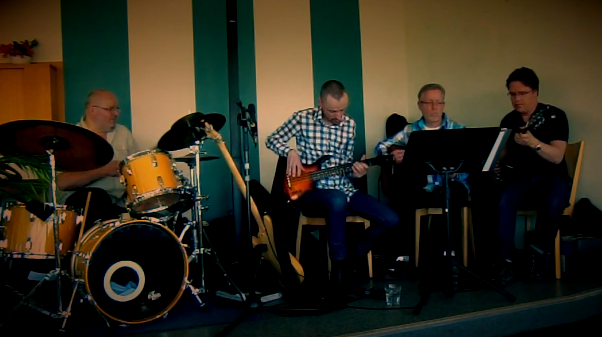
For the first time I’m playing a Kala S.U.B. solid body UBass! The video is from last Sunday’s annual gig at Svampen. (A water tower with a ”roof top” restaurant in Örebro, Sweden).
I will make more videos and a review/test about the solid body UBass version soon. Until then here is a song from the gig. It’s a song by Bobby Gentry called Ode to Billy Joe. There is also a version with Swedish lyrics called Jon Andreas Visa. Here is a link to a great version by my second cousin Rebecka Thörnqvist and pianist Anders Widmark.
More UBass S.U.B. videos, reviews and lessons soon!
[Test Report]: Gigging with the Kala Ubass S.U.B
Hi there!
Right now I’m playing a Sunday gig at the annual Svampens Dag (The Day of the Mushroom!?) in Örebro, Sweden.
See this previous post from last year.
I just got back from a trade show in Gothenburg yesterday. It was the annual Fuzz Guitar Show, the biggest in Scandinavia.
The Scandinavian retailer of the Kala brand Akustikken.dk gave me a Kala Ubass S.U.B to review.
So I decided to ‘jump-right-in’ and bring it to today’s gig!
This UBass, with the sunburst finish, just arrived to the retailer and the strings are not yet ‘stabilized’ so I guess there will be a few turns on the tuning pegs 🙂
Stay tuned for an in depth review in Swedish (and English) soon!


[Studio Report] Duo Recording with Nelson Faria

Hi!
This Tuesday [April 24] morning I recorded with the great Nelson Faria. Read about him here and at [www.nelsonfaria.com/music]
I will post some ”audio/video-snippets” from the recording but we’ll start with a couple of pics 🙂
Please note that I recorded the UBass both direct (from my Headway EDB-1, see this post) and with two different microphones. I’m writing a seperate blog post on the use of microphones to record the acoustic tone of the UBass. Stay tuned for more on this topic!
A ”Jammin’ with my Kala UBass video” on the Kala homepage!

See this live at http://www.kalabrand.com/
Ubass Lesson | Make a wish – what song or style will be next?

A little Q for U!
Is there any song or style that you want me to cover in a future video lesson?
It could be everything from a ‘note-for-note-true-to-the-original-transcription’
to a more free interpretation of that song or style. Ask away!
I hope I’ll be able to make at least some of your wishes come true 🙂
If you want a specific song or a style not represented in the poll below please write it on the ‘free-text’ alternative and why not drop me a line with your suggestions to:
ubasslessons@gmail.com
UBass Lesson | 7 ”Satellit” (Part 2)

Hi!
Time for part 2!
Now it’s time to learn/play the bass part.
Tune up your Ubass (or any bass really!) to 440 Hz and get ready!
The video will go through the whole song and then break down the different parts and riffs!
Please check out part 1 to get some in-depth analysis about the music theory behind the different riffs and parts of the song
There are three parts in this – plus 12 minute – video lesson:
1. The whole song in original tempo (108 bpm) with three video angles!
2. The same as 1. but with the sheet music in the top of the video. (If you want to download the sheet music see info below!)
3. The different parts of the song (Intro/solo/outro, verse and chorus) but in half tempo (54 bpm).
Slurs and slides
As you can hear and hopefully see I use some ‘ornaments’ to ‘spice up’ the bass part. If you want me to make it more clear on how to play these drop me an email to: ubasslessons@gmail.com
4/4 or 12/8?
As a compliment to part 1 of this lesson here is a short video on the differences and similarities of 4/4 and 12/8 notation using Riff 1 (intro/solo/outro) from Satellit as example!
Download PDF?
Please send email to ubasslesson@gmail.com for a link to a downloadable PDF!
Good luck!
/Magnus
UBass Lesson | 7 ”Satellit” (Part 1)
Hi!
Ok now it’s time for part one of my lesson on the song ”Satellit” by Ted and Kenneth Gardestad. (For a short live clip of this song go to this blog post).
In part 1 we will focus of the music theory side of the song.
Parts Of The Lesson
We will look into triplet/shuffle playing and use the classic Swedish pop song as our ”tool”.
(Read more about the song in this post.)
There are other songs in this shuffle or 12/8 style that you might be more familiar with. One of the most famous might be ”Hold the line” (by Toto).
We will also check out what scales (modes) the different riffs derive from.
Triplets and Shuffle
In the sheet music I use triplets to write down the bass part. (See video – coming soon in Part 2 of this lesson). You can think of an 8th note triplet as three 8th notes evenly spaced where you normally would play just two. One way of describing this could be with the use of the 12/8 time signature. When I describe shuffle rhythm I often use the 12/8 example and the take away the middle 8th note of every group of three 8th’s. For more on shuffle rhythms and a way of playing those see this video.
Either way you should divide the pulse into four beats. In 4/4 it will be four quarter notes and in 12/8 it will be four dotted quarter notes.
Since ”Satellit” is mainly based on triplets (or groups of three 8th notes) I choose to write it in 4/4. Jazz notation: In the case of swing music notation you often use regular 8th notes and write at the top of the score or lead sheet that the 8th notes should be played with swing/shuffle rhythm feeling. That way you don’t have to write out every triplet.
Here’s a pic of the how shuffle notation looks like in 4/4 and 12/8:
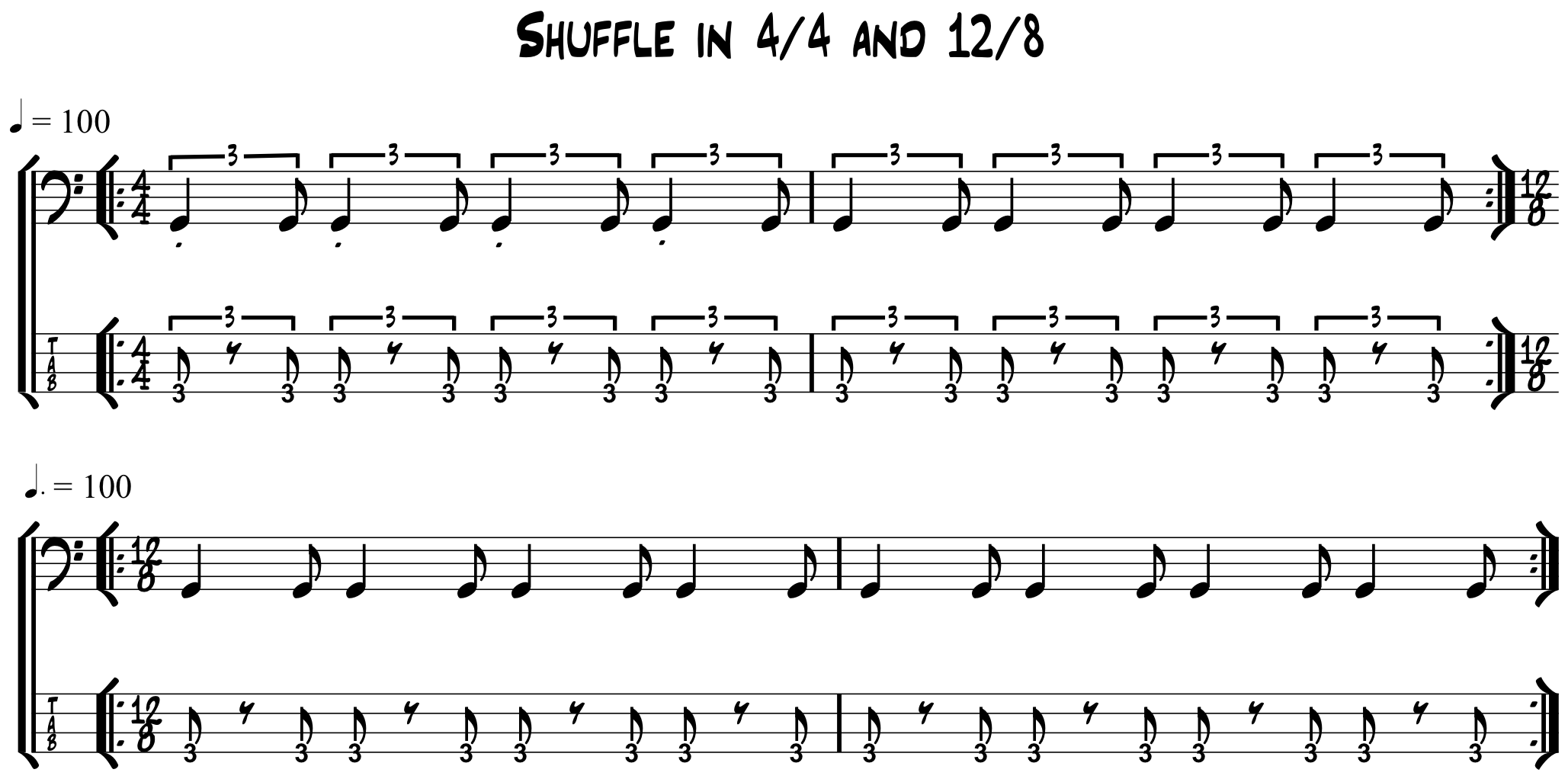
Besides the 8th note triplets there are also a couple of quarter note triplets. The same method is used here. You ”squeeze” three quarter notes in the space of two. These triplets are a bit harder to do. But if you play along with the video (in part 2) and maybe the original recording or why not other songs using these triplets I think it can help you get good at this quickly!
For more on triplets please check out John Goldsbys column in Bass Player!
Riffs and what scales they are made from
There are two main riffs in ‘Satellit”. The whole song starts with Riff 1. In the chorus it’s time for Riff 2. Riff 1 is also played during the guitar solo and outro.


Okey. What are the scales/modes used in these riffs?
Riff 1 is clearly based on the G minor pentatonic scale. This scale uses five notes from the G minor scale.
G minor scale: G-A-B flat–C–D-E flat-F–G
G minor pentatonic: G-B flat-C-D-F-G.
Riff 1 starts on scale degree 1 moves down to scale degree 7 and then climbes up the scale. Let’s devide the riff into three phrases.
Phrase 1: 1 – b7 – 1 – b3 – 4 – 5
Phrase 2: b7 – 1 – 4 – 5 – b3 – 4 – b3 – 1 – b7 – 1 – b7 – 1 – b3 – 1 – b7
Phrase 3: 4 – 5 – b7 – 4 – 5 – b7 – 5 – 4
I think this is a nice way to really make the most of this scale. Making up little motifs based on small parts of the scale and the make connections between these motifs using nothing more than notes from the scale!
Riff 2 is really based only on the Bb major scale! And this works really well because the the key of the tune is B flat major. Let’s break it down a little bit.
B flat major: B flat-C-D-E flat-F-G-A-B
If we build chords based on the Bb major scale we get these chords:
Bb major – C minor – D minor – Eb major – F major – G major – A minor b5
In the chorus we have these chords:
Bb major – D minor 7 – Eb major – F11. (F11 is a E flat major triad with F as bass note). As you can see all of these chords derive from the B flat major scale and chords based on that scale. This means the B flat major scale will work throughout the chorus!
On the first chord (B flat major) the riff starts on the 3rd degree (Bb: 3-2-1) and then moves to next chord using the same three notes landing on the D. After this we have a long scalar motion starting on the Eb (the 4th degee of the Bb major scale) moving all the way to the high Bb.
Conclusion
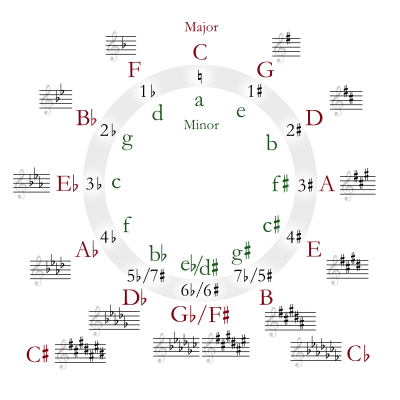
Now we know that Riff 1 is based on G minor pentatonic and the chorus riff is based on the Bb major scale. How come this works? Well it’s because these to keys are related [G minor is the relative minor to Bb major] and use the same notes with different starting points/notes! Check out this picture of the circle of fifth. As you can see B flat major and G minor both have flatted B and E!
Links
Watch the original version with Ted Gärdestad from the Melodifestivalen 1979 (Swedish TV) on YouTube.
Stay tuned for part 2 for a video lesson on how you can play the bass part!
/Magnus
[Studio UBass] Recording with Haroldo and Jon
Studio Report!
I have just completed a course in Brazilian Popular Music at the Örebro University.
Haroldo Mauro Jr was one of the teachers. (He is a professor at the UniRio University
in Rio de Janeiro). Since the university in Rio and Örebro has a exchange program
he has been working in Sweden this spring. (His classes included the history of
Bossa Nova and ensemble playing).
I asked him if he wanted to play with me and maybe do some recording too.
The clip below is one of the songs we ended up recording.
Be prepared to hear great piano playing by Haroldo!
The song is our version of the Lyle Mays (Pat Metheny Group etc.) song ‘Before You Go’.
Hopefully I will be able to post more music from our recordings!
A big thanks to Jon Eriksson (on drums) for great playing! He recently got back from
five months in Rio as an exchange student in the program I wrote about above.
Play UBass!
Read more about the course here.
Links:
Haroldo Mauro Jr.
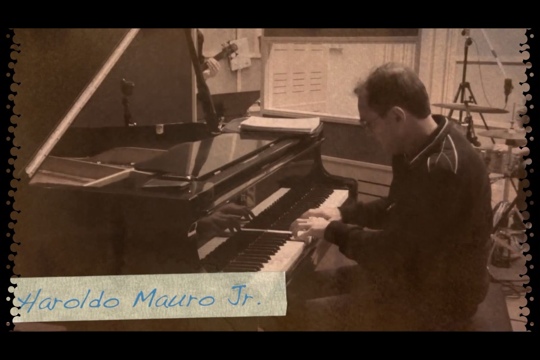
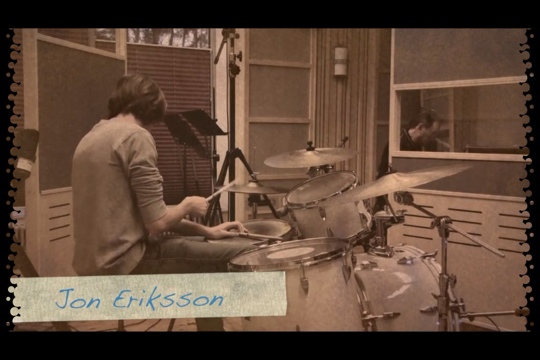
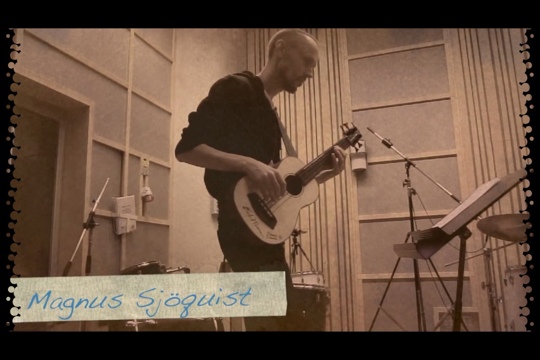
A new song lesson is in the making…
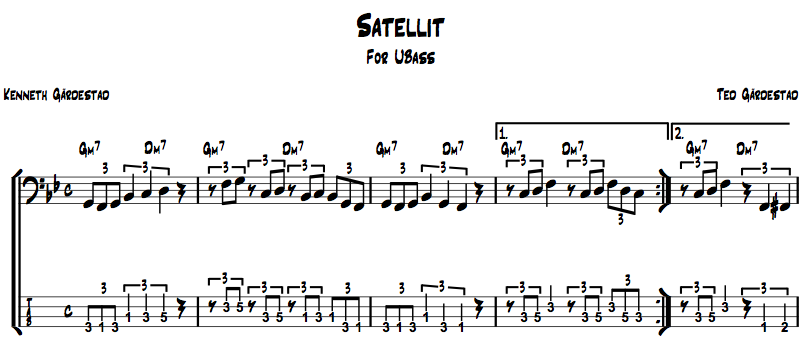
I’m working on a new UBass song lesson! It’s a song that I’ve been playing a couple of times the last few years. Most recently it was a couple of weeks ago. You can read about it in my last post.
Probably one of the most recognizable songs by Kenneth and Ted Gärdestad. It was featured representing Sweden in the Eurovision Song Contest in Israel 1979. This classic pop song has some really cool unison bass/guitar parts as well as a bubbly verse. One of the musicians on the original recordings was Janne Schaffer. He was responsible for making up these great riffs!
(Janne did get some inspiration from hanging at a studio in LA when some studio musicians were jammin’ on what would later be the ‘quite’ famous song ‘Hold the line’ by Toto… 🙂
Here’s a short clip from the concert that featured Janne Schaffer (guitar), Teds brother Kenneth (narration), pop singer Erik Linder and a big local amateur choir led by Krister Kallin and Magdalena Eriksson. Playing with me in the band was Fredrik Kjellgren, keyboards, Gunnar Hjorth, guitar and Oscar Eriksson, drums.
The lesson will be posted soon!
 Play UBass!