Long time no see! I know I’m not that frequent with my blog posts… There is definitely more happening at instagram.com/playubass so make sure to follow me there to keep updated with all things ukulele bass!
In July, I was able to pay a visit to the Aquila Corde string factory in northern Italy!
Back story
I have been using Aquila strings from the very beginning of my ukulele bass journey. You can read about the evolution of Aquila strings for ukulele bass in previous posts. See below!
Aquila has been one of the string companies that have pushed the development of strings for ukulele bass the most.
Back in 2012, they started to offer the Thunder gut string as an option for the only other string on the market at the time, the Pahoehoe by Road Toad Music. Since then, Thunder red, Thunder black, and Thunder brown have followed.
Besides these nylgut strings, Aquila started to offer two wound strings in 2024 called Flat- and round spirals.
I got to try these strings early and made demo videos of them.
My demo videos for the Flat and round spiral strings by Aquila Corde.
Factory tour
Mimmo Peruffo and I at my visit to the Aquila Corde HQ in Vicenza, Italy
Mimmo Peruffo is the owner of Aquila Corde strings. He is truly an inventor and has developed many different strings since he started the company back in 1991.
Besides all the different synthetic strings for acoustic instruments, Aquila Corde is one of the very few companies in the world that still produces gut strings.
It was amazing to see how strings are made and get more insight into the process. I was not able to document the whole tour, but I will share a little video where Mr Peruffo makes two different wound strings by hand.
Besides meeting Mimmo Peruffo, I also had the opportunity to meet and hang out with Luca Scalco from Aquila. It was great to meet him in person!
If you haven’t tried out any of the Aquila strings for ukulele bass yet, it’s time!
Luca Scalco from Aquila Corde and me in Vicenza, Italy
I did a little Holiday music poll on my Instagram and at the ukulele bass-focused Facebook group; Ubass Freaks and the song that got the most votes was ”Rockin’ Around The Christmas Tree” made famous by singer Brenda Lee.
You might remember his name if you have followed this blog for a while. I wrote about him in a blog post from 2011. I was fortunate to meet Mr. Moore in person at the famous bluegrass venue; The Station Inn, Nashville, TN back in 2011. I chatted with bassist Dennis Crouch in the intermission, he played with the Western Swing group, The Time Jumpers that night. He saw Mr Moore enter the venue and wanted to pay homage to the bass legend. A lucky moment for me since I could talk to him for a while and he agreed to write his autograph on my first ukulele bass, bought in 2010, that I happened to have with me! 🙂
Autographs from two masters of the upright bass
I decided to cover both the bass part and the tic-tac part of this classic!
(U)Bass part
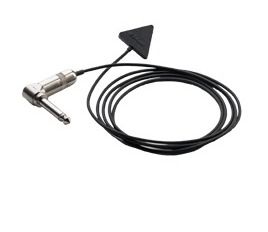
The bass part was played on an upright at the original recording session and I decided to record my version on my spruce Kala UBass. It has the Aquila Flat Spirals strings and was recorded with a combination of the built-in piezo and an Ehrlund EAP contact mic. I used the two-channel EBS Stanley Clarke Acoustic Preamp to sum the two signals and used the XLR-DI out into my audio interface.
I did my own transcription based on others I found. The one I used as a starting point was mostly right but there were a couple of places where I added some alterations. In the on-screen sheet music (also available for FREE at payhip.com/playubass) the way I played the bass part is included in the tablature. I always try to mimic how I would play the bass parts on an actual upright bass to get the most authentic upright assimilation when playing ukulele bass.
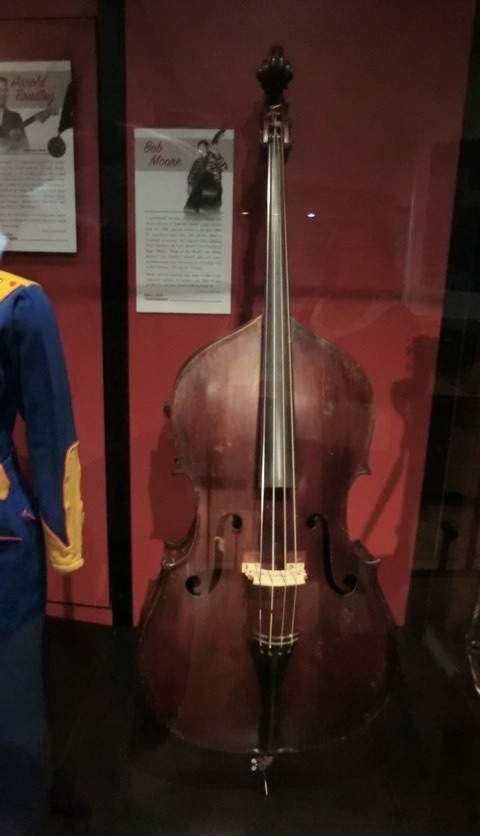
This bass was owned and played by Mr. Bob Moore. It could even be the bass that you hear on the original recording. I took this picture on my first visit to The Country Hall of Fame and Museum back in 2011
Tic-Tac part
A typical tic-tac bass part was added to get some more momentum. The sound of the upright was hard to record and the tone was a bit lost when you heard the recordings on small speakers the most radios of the time had. To compliment the upright bass tone a baritone guitar was used to play the bass part with a more ”snappy” sound. I always thought that the baritone guitar always played exactly the same thing as the uptight bass part.
When listening closely to Rockin’ Around The Christmas Tree I heard that the tic-tac part was a new part used to compliment or augment the bass part. Instead of a baritone guitar I used one of my UBasses on my recording. I tried my fretted Kala Striped Ebony UBass with the Aquila Round Spirals strings. These strings have a brighter sound than the Aquila Flat Spirals used on the bass part (See above) and helped the tic-tac part to stand out and augment the bass part. You can download The tic-tac part for FREE at payhip.com/playubass together with the bass part and backing tracks in two tempos.
I hope you will enjoy playing these parts as much as I did!
Good luck with your playing, and please feel free to comment on this blog post if you have any questions!
This place is magical! It’s where I took the photos for the cover to my first Learn to play Ubass ebook!
Hi,
In 2017, Magnus Sjöquist released the interactive educational ebook, Learn to Play the UBass – Basic Techniques, first in the Apple Books format and then as an ePub. This has now been converted the ebook/ePub into an online course. This is the first of hopefully many online courses for ukulele bass and bass players.
To celebrate the course format launch there is a two-week Summer Sale! Check out the course here: https://payhip.com/b/ctG4w
NEWS! The enrolled students now have the possibility to submit an assignment (Make your own bass line to a Turnaround) and get feedback from Magnus!
There are more online courses in development and the possibility of added online group live sessions and/or study groups later this year. These will work as an add-on to some of the upcoming courses.
Launch offer to existing buyers of the eBook/ePub version! If you have bought the eBook/ePub before June 28 2024, and want to try the course, please send an email to ubasslessons@gmail.com You will be sent a coupon code so you can enroll the course for FREE. If you have bought the Apple Books (eBook) version please send a screenshot of your Apple Books Bookshelf (and/or Apple Books Receipt) to prove you have bought a copy!
If you have bought the ePub-version (on PayHip) we already have your email on file so just make sure to send an email from the same address. No need to add a screen shot!
It has been quite a long time since I posted here so it’s definitely time to start doing it again more frequently!
Please let me know in the comments if there are any specific topics you want me to cover!
Happy Birthday to Stevie Wonder!
I know Mr. Wonder had his birthday yesterday but why not celebrate him and his music today too…and tomorrow and…
Besides playing ukulele bass one of my main day job has been as a music educator at a Swedish high school with an arts program.
The students in the second year are just about to finish a project playing, you guessed it, Stevie Wonder songs!
The group that I’m mentoring has decided to play two real classics, Sir Duke and Master Blaster.
Both these tunes have really nice unison interludes. Maybe I should do a ukulele bass cover of Sir Duke and show how I play it!? Because the ukulele bass has a shorter scale length there can be options available for playing some of the sections in ways not possible on a regular scale bass. It’s always nice to try and find more than one way of playing a bass part even if it’s just a small section that will benefit from a way of playing that suits YOUR playing!
I have made a couple of video lessons playing Stevie Wonder here on this blog. Let’s revisit them!
And please don’t hesitate to comment below and let me know what you want me to cover on this blog hereafter!
Introduction I started playing Kala UBasses back in 2010. The first two years I only used the original Road Toad MusicPahoehoe strings, there wasn’t really any other option.
In 2012 the Italian string company Aquila released a string made for super short scale ukulele basses called Thundergut. This string was “white” and had a different “rubber” blend. It was “stiffer” and had a different sound and feel compared to the Pahoehoe.
Since then I have tried the different offerings Aquila has put out, including the Thunder Reds and Thunderblack. See this playlist for related videos if you want to check out my thoughts about those strings. I have also written dedicated blog posts about these strings over at playubass.com. See links below!
In 2021 a new string has been released called Thunderbrown and there are new formulas for the Thunderblack and Thunder Reds strings as well.
On November 10th (2021) I put a set of the Thunderbrown strings on my 2017 acoustic/electric Kala California Ubass. I sat in at a friend’s concert that same night and played my UBass. This was of course pretty risky since it takes a little while for all ”rubber” strings to settle in and hold the tuning… A smartphone video from that show will give you a first ”look”! (It’s included in the video below!)
The Thunderbrown strings are probably the best ”rubber” strings I’ve played! They seem to have the best of all, playability, low end, and tone. On a fretless ukulele bass, I’m even able to get a convincing ”mwah” sound! I have made a series of videos to highlight the tone, loudness, and playability of the Aquila Thunderbrown strings. (For full versions of these different videos check out this Aquila playlist!)
Conclusion I believe these strings are something you should try if you like the feel of ”rubbery” strings and want to try something new. This is actually the first time I restring this UBass. I really love the Pahoehoe strings and they served me well on the UBass for almost 4 years. Trying out the Thunderbrown strings on this UBass is a whole different thing. Especially the E-string is so, so very good. It’s tight and feels quite a bit like the E-string on the Thunder Reds set but it seems to have even more focus and maybe a bit more tension as well. I encourage you all to try them out! Next up is trying the New formula Thunderblack strings on my ”vintage” fretted Ubass!
Until next time! (Please subscribe to this blog, follow me on Facebook and Instagram so you don’t miss any UBass news from me!
The new song from Silk Sonic was just released. I decided to transcribe it and record it with my Kala SUB. I use a magnetic mic and this is part of my testing for an upcoming blog post / YouTube-video on using magnetic mics on a solid body UBass. I think the sound is really great and can mimic the sound of a P-bass or short scale (~30″) bass!
My “quest” for a great UBass sound started pretty much the moment I played a UBass for the first time. You can read about how it all started here https://playubass.com/2010/12/26/the-first-pictures-of-my-kala-ubass/ I can’t say exactly when I first started thinking about tone and sound. I think it was early on when my musical journey began. It wasn’t a conscious thing at first but now when music has been a big part of my life for so long I have come to understand that it’s very important to me. I’m not alone, this is something many musicians think about daily. The search for the optimal and “perfect” sound is one of the things that drives us to become better musicians.
How to pick-up the sound of the ubass strings
Although a lot has happened since I started to play ubass back in 2010 one thing has been constant, the way ukulele basses are constructed and designed regarding how to pick up the sound of the vibrating string.
It spells: under-saddle piezo pickups
What we can use to pick up those vibrating strings all comes down to what stings we use. If a string has some kind of metal that is magnetic, like steel or nickel, the options are quite a few regarding picking up those string vibrations. You can use a magnetic mic, a piezo, or a contact mic.
When the ubass was first introduced only one type of string was available and it was made of synthetic rubber, polyurethane (Insert link: https://en.wikipedia.org/wiki/Polyurethane ), and there is no metal whatsoever so a magnetic mic wasn’t an option.
Manufacturers decided to use piezo pickups since they can pick up the vibration regardless of the material. They are also good at picking up sound ”locally” i.e. mostly in the bridge where they are installed under the big saddle.
The piezo can reproduce low end in a good way but high frequencies can sound pretty harsh. This is however not a big deal with the Pahoehoe (or other “rubbery/plastic” strings since they lack pretty much all frequencies above 1000 Hz…
A piezo can work very well for ukelele basses and I’ve happily played all my UBasses since day one getting a great sound. The biggest issue is getting an even volume across all strings. Still, I haven’t seen this as a big problem. If, for example, my e-sting has been lower in volume I have tried to rock it a bit at the bridge to find the sweet spot and then compensated with a playing technique where I play the e-string a bit louder than the other strings to get a good balance.
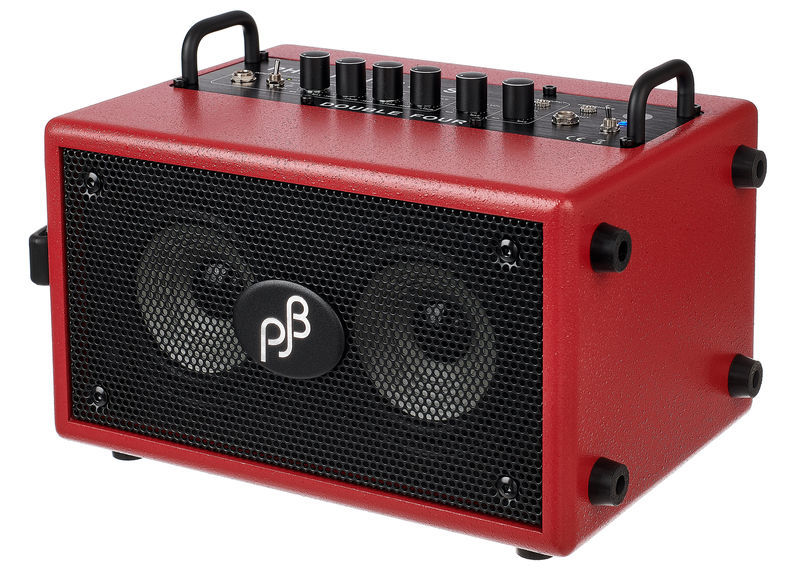
The Phil Jones Bass Double Four Combo might be small but it is very competent in reproducing the sweet low end of a UBass
Having a great amp is also important. The amp has to be able to reproduce those low frequencies picked up by the piezo. Some pre-amps have the option to engage a low cut so the lowest frequencies are cut out and that can help to get a better sound. I have never used these live but when I record UBass (or any bass really) I always put on a low cut filter to tame the lowest frequencies. If you’re interested in getting to know more about how to record UBass please leave a comment below and I’ll try to write a blog post (or more) about this topic! As new strings have been developed more options for picking up and amplifying the UBass are now available. Some strings now have enough metal in them so they can be used with a magnetic mic. I have been experimenting a lot with this but there isn’t any commercial UBass with this option on the market yet. But this will hopefully change in the future.
One goal with the UBass is to get a sound and feel similar to an upright bass.
This has been available since day one with the Pahoehoe strings. These strings have a very big and round sound but sometimes it is hard to get a clear and precise tone (i.e. pitch) because of the lack of high mids and treble.
There are now options and some strings are manufactured with a mix of materials.
There are round wound strings and flat wound strings that have a nylon silk core with some kind of metal wrapped around the core.
Here’s a song recorded with the round wounds strings:
Here’s a UBass duet jam where both UBasses uses a flat wound string
In the Summer of 2018, I decided to record a version of the Gershwin classic Summertime.
I wanted to include a technique I’ve developed where I play percussive rhythms with my right hand on the body of the ubass while I play notes using hammer-ons with my left hand on the fretboard. Hard to understand what I mean?
Here’s a link to the video. I guess it’s easier to see and hear this instead of me trying to explain in words!
To be able to pick up those rhythms played with my right hand I had to find something to compliment the built-in piezo…
Eureka – I found it!
I remembered a visit to the Fuzz Guitar Show in Gothenburg back in 2013. One of the companies having a booth at the show was Ehrlund Microphones, a Swedish company making high-end microphones. They also make a contact mic that is very popular among musicians playing acoustic instruments.
I briefly tried it on the UBass I brought but wasn’t blown away since they didn’t have a bass amplifier available that was able to deliver those lovely low-end frequencies. Though with an amp that’s able to deliver and amplify the low-end it’s a whole other story…
Fast forward to 2018. One of my colleagues plays violin and had one of the Ehrlund contact mics he uses when he wants to amplify his instrument in a live setting. I remembered that time I tried one back in 2013 and decided to see what I thought about it now.
My goal was to pick up the percussive elements using it in conjunction with the built-in piezo. The contact mic, from now on referred to as the Ehrlund EAP (Ehrlund Acoustic Pickup), worked like a charm and I was able to get a great sound of my bass-drum-instrument!
My first video from 2018 using the piezo+EAP combo:
Next level!
For a while, I have thought about the possibility of using only the EAP to pick up all the sounds of the ubass. Here’s part of the press text for the Ehrlund EAP: ”The Ehrlund Acoustic Pickup (EAP) is a linear contact microphone for instruments with an acoustic sound box such as the guitar, violin, double bass, and ethno instruments.” Well, the UBass fits the above description pretty well!
PLACEMENT – WHERE TO PUT THE EAP
Since a contact mic is made to pick up the sound of the surface, where it’s applied with adhesive putty, it’s important to find the spot where they can pick up the best sound. The UBass has a pretty small body so the search has to be based on a combination of finding a sweet spot with the practicality of a place in the body that’s not in the way of the desired playing technique. You also have to be super conscious about your playing technique since the Ehrlund EAP will pick up just about everything you do!
Placement One. I have two EAPs so experimenting with different positions and A B these is super convenient. In the first example we will listen to the sound we get with the EAP close to the bridge. Treble Side EAP Bass Side EAP
Placement Two Under the top near the sound hole and under the top (upper bout) In combination with the built in under saddle piezo
I hereby proudly present some new music composed with and for solid body UBasses!
“Reflections” (Magnus Sjoquist) started out as a chord progression. The descending chords are played with a simple triplet rhythm throughout. Over this sequence of chords I started to improvise and captured a take. My initial goal was to pick and choose parts of this improvised recording into a crafted melody. When I revisited the recording later my goal changed. I decided not to mess with it at all and keep it as is. Instead of picking out parts what you hear is that first improvised recorded play-through.
When coming back to this demo later I wanted to flesh out the arrangement and started by adding a shaker and Udo percussion parts.
It wasn’t enough so a string arrangement was made and my old 1950’s Czech upright has a little cameo twice.
The melody and chord parts are played on my custom Kala solid body UBass tuned EADGC and as a final addition my Kala solid body fretless 5, also tuned EADGC, is used for the intro and outro melody.
I hope you will enjoy listening to (and watching, If you read this on YouTube) my new composition: “Reflections”!
This is an announcement for two upcoming releases of original music composed by me. The first release has been available on bandcamp.com awhile but will now be released on more major digital outlets.
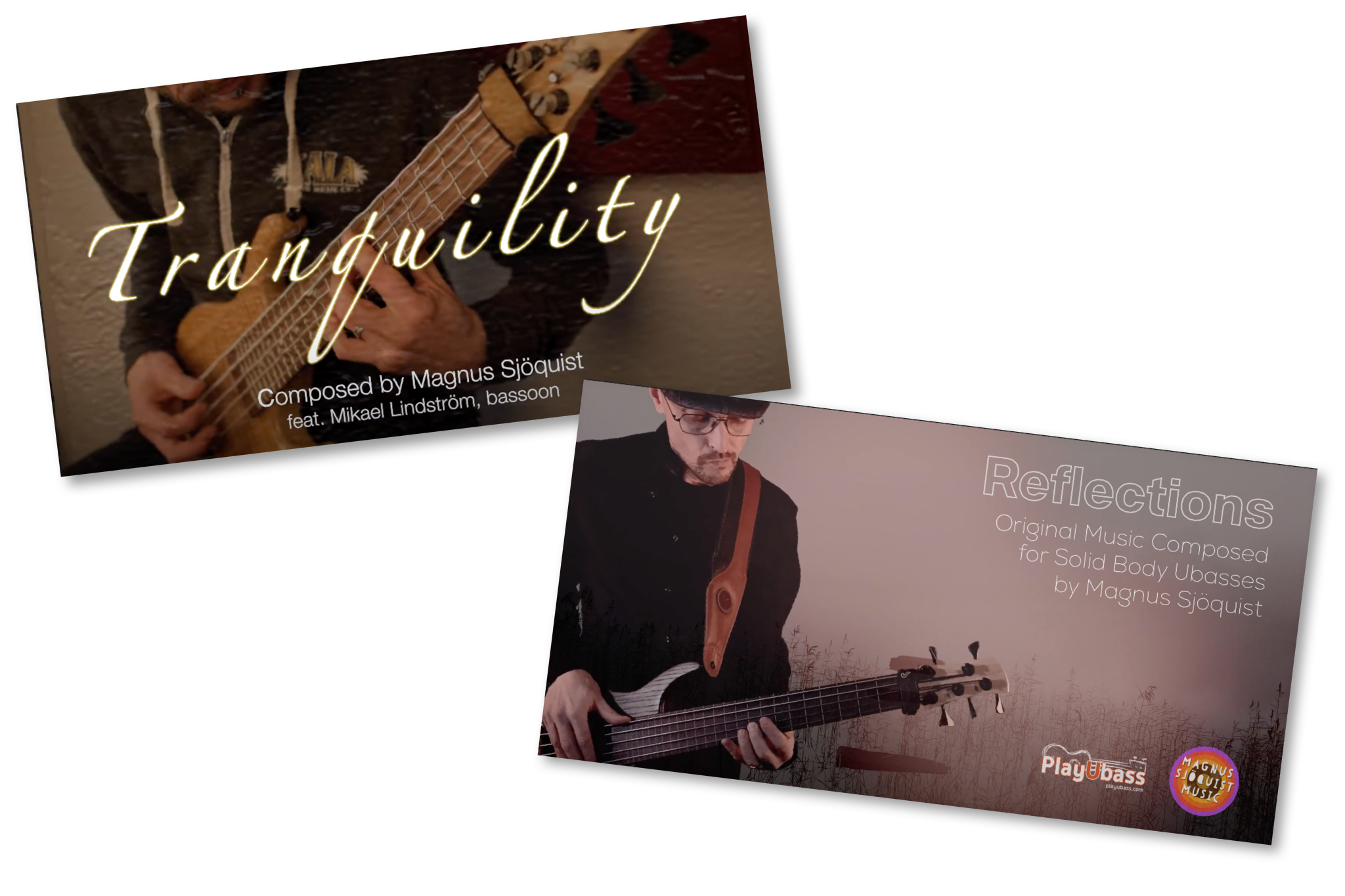
First up is ”Tranquility”. This was composed, arranged and recorded back in 2018. The song features my good friend, principal solo bassoonist for the Swedish Chamber Orchestra, Mikael Lindström. The arrangement is based around a chord progression played on a solid body ubass tuned EADGC. Besides the chord part both melody and solo parts are played on that same EADGC tuned ubass.
You can already hear the song on bandcamp.com, Spotify, Apple Music and other digital outlets. The Full video will be released this weekend, Saturday March 6! See Teaser video below!
Next up ”Reflections”. This song started out as a chord progression. The descending chords are played with a simple triplet rhythm throughout. Over this sequence of chords I started to improvise and captured a take. My initial goal was to pick and choose parts of this improvised recording into a crafted melody. When I revisited the recording later my goal changed. I decided not to mess with it at all and keep it as is. Instead of picking out parts what you hear is that first improvised recorded play-through. Read more on a dedicated blog post when the song is released!
Release date: April 2 2021 on Spotify, Apple Music and other digital outlets
Learn to play Silent Night as a solo ubass arrangement Link to videos below!
It’s Christmas time and although it has been a crazy year with the ongoing pandemic I hope some Holiday music can help sooth and heal at least a little bit.
The arrangement is based on the melody and a simple bass part that has mostly a root motion meaning I go from root to root in the chord progression. I choose the key of A major simply because the possibility to use a lot of open strings for the bass line part of the arrangement. This way I can focus on the melody and also get a bass part with a long legato feel. I want to make a contrast between the melody and bass rhythm if possible.
It would not have been so nice if I used the same rhythm in the melody and bass part throughout the arrangement. Although we as bass players really love bass this technique will let us focusing on the most important part of a song, its melody!
Tricky Bit 1: Playing the “19th fret” harmonic (a D) on the G string
Tricky Bit 1: The highest note of the melody is a D. Since most Ubasses only has 16 frets and the D we want is located at the 19th fret we need to play the D as a natural harmonic. This note can be found where the 19th fret would have been if the fretboard was extended that far. You play a harmonic but lightly touching the string and then play with your plucking hand. You might need to play a little bit harder with the plucking hand than you usually play to get the harmonic to “ring”.
Extra info: If you play a 12th fret harmonic you get the same note as if you press down on the 12th fret. When you play the 24th fret harmonic you get a pitch that is one octave higher. If you can find the spot in between the 24th fret and the bridge you will get a note that is yet another octave higher. And now the crazy bit. If you do the same dividing the string from the 12th fret to the nut you will get the same results as in the 12th fret to the bridge area! More on this in a later blog post.
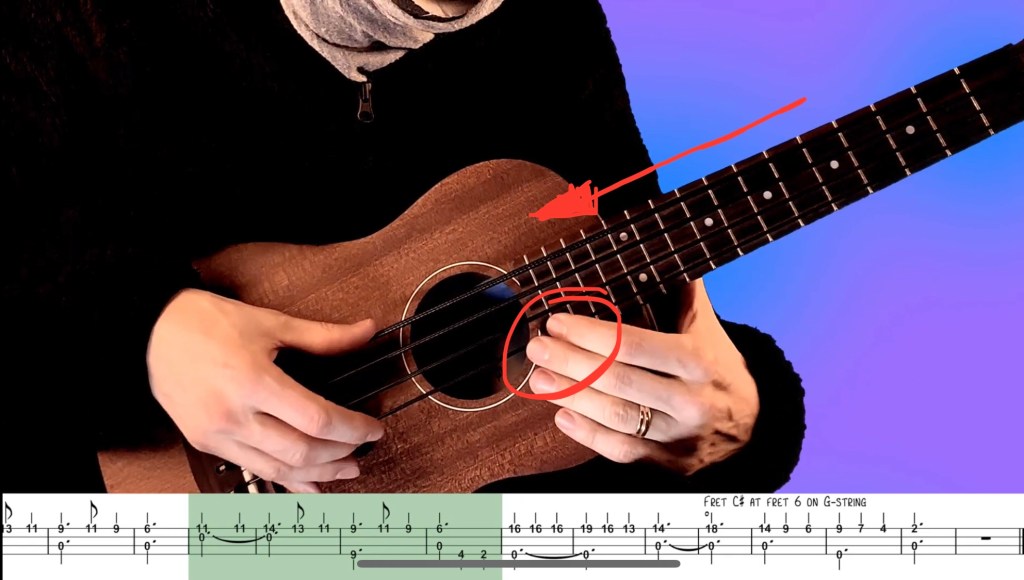
Tricky Bit 2: Playing the C# as a false harmonic
Tricky Bit 2: To get the C# you need to use a technique called false harmonics. The false harmonic technique is based on the same technique you use when playing a natural harmonic. You want to get the pitch that would have been find on the 18th fret. To get this note you fret the C# at fret 6 on the G-string. Then you find the spot exactly in the middle between the fretted C# and the bridge. You need to play that harmonic with you plucking hand. There are different ways of doing that. Here I’m using the first finger of my plucking hand on that “half-way-point”. (See Extra info!) I then pluck with the ring finger of my plucking hand. This will take some practice to find the right spot and get the note to ring and sound as close to the regularly fretted notes! Play slow and gradually add speed!
Tricky Bit 3: Getting from that passing note bass part to the part where you play those harmonics (Tricky Bit 1 & 2) is a bit challenging too. Aim for the B note…Tricky Bit 3: Aim set for the B note!
Tricky Bit 3: Getting from to the part with “Tricky Bit 1 & 2” can also be a little challenge since you need to quickly go from the lowest to the highest part of the fretboard. Practice slow and make sure you aim for that B. Best way to do that is to “look ahead” and aim with your eyes. That way you’re helping your brain to gules your hand!
In the performance video I play only one verse of the song. My goal is to work more on this arrangement, maybe add an intro, develop a second verse with the use of other rhythms and maybe some re-harmonization and so on. I decided to record this very short version to give you something to work on during the Holiday’s!
Maybe this will be your first go at playing a solo ubass arrangement? I hope this will inspire you to make your own solo arrangements. The melody and bass approach is a great staring point! Please let me know if you decide to make your own arrangements. I’d love to feature your arrangement on playubass.com if you want to share something!
I wish you all a Merry Christmas And a Happy New 2021! /Magnus
Performance video with standard notation
Lesson video with TAB and last 11 bars in half tempo









 Play UBass!